The all-rounder amongst trial frames
Everyone who has anything to do with the prescription of eyeglasses has heard of OCULUS Universal Trial Frames.
Functions:
- Space for a total of 10 tl trial lenses of 38 mm diameter*
- PD range from 46 – 78 mm
- Adjustable temple tilt and length
- Smooth axis adjustment
- CVD scale
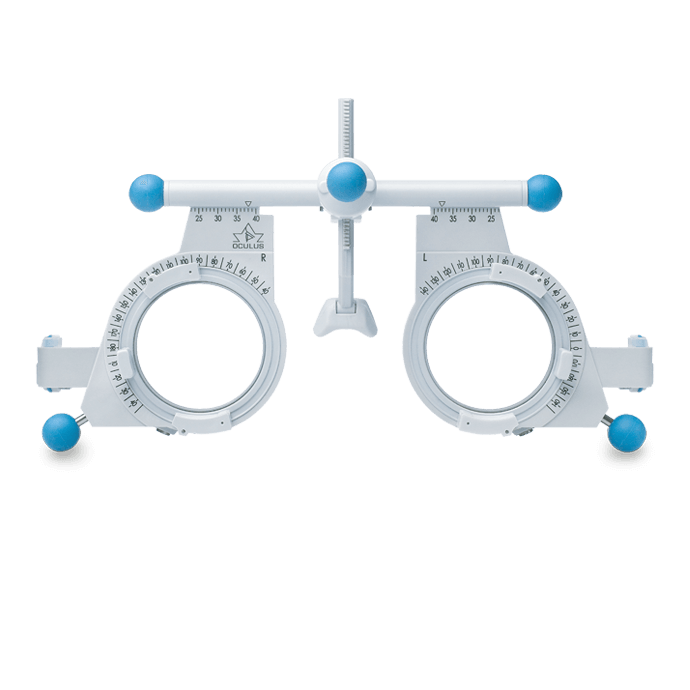
Functions

Features
- Space for a total of 10 tl trial lenses of 38 mm diameter*
- PD range from 46 – 78 mm
- Adjustable temple tilt and length
- Smooth axis adjustment
- CVD scale

Ergonomics
- Easy trial lens insertion
- Self-braking nose-bridge adjustment
- User-friendly controls in “soft design”

Comfort & Material
- Operating controls are a good distance away from the patient’s face
- Minimal pressure thanks to large rests and optimal weight distribution
- Closed frame temple design prevents hair from getting caught
- Flexible and anatomically adjustable mixed-material ear pieces
- No lubricants needed
- Dermatologist recommended safe materials

Compatibility & Design
- Compatible with DIN and BSI Standard trial lenses
- Slip-on polarizing filter with 2 settings (near/distance) available as an optional extra
- Timeless, attractive design increases patient acceptance
- iF-Award winner

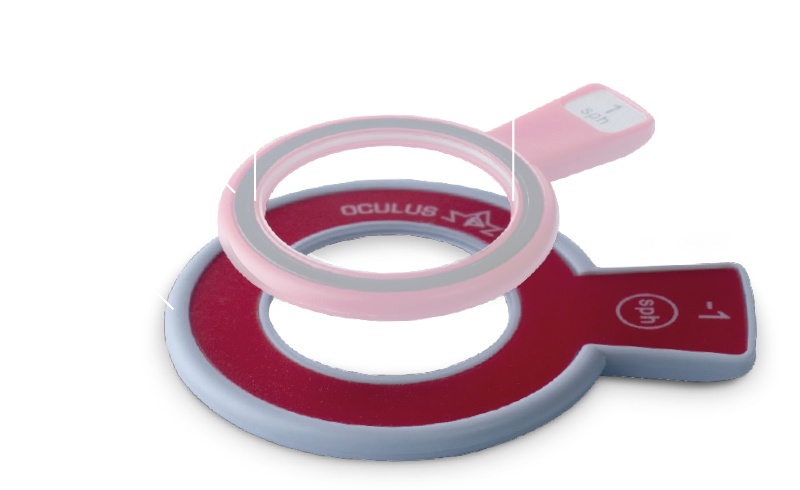
Trial lenses according to DIN EN ISO 9801 with a rim diameter of 38 mm (lens diameter 21 mm), such as the OCULUS trial lens “tl” (trial lens), are compatible with the Universal Trial Frame UB 3+, UB 4, UB 6 and Half-eye Trial Frames.
FAQ
Universal Trial Frames UB 3/UB 3+, UB 4 and UB 6 are all suitable for any trial lens conforming to DIN EN ISO 9801 and having a rim diameter of 38 mm, such as a OCULUS “tl” trial lens.
However, our Universal Trial Frame UB 5 for small heads requires trial lenses of the “tls” line with a diameter of 28 mm. These also conform to DIN EN ISO 9801 and are available nowhere in the world but from OCULUS.
Yes, all spare parts are available. Please contact the distributor from whom you bought your trial frame.
Yes, all components of every one of our Universal Trial Frames are assembled manually with great precision. Here too, we stay true to our quality claim: Made in Germany – made by OCULUS.
Yes, polarizing filters are always optionally available. Those for the UB 6 have a clip for easy mounting, while those for the UB 4 and UB 5 are to be directly slipped onto the trial frame.
Polarizing filters with a clip as well as those of the slip-on type are for lateral mounting and can be easily flipped to the side when not needed.
On the UB 3/UB 3+ the polarizing filter has a central mount and can be simply removed after use. All linear polarizing filters are reversible.
Circular polarizing filters are available both with a clip and in a slip-on version.
There are also circular polarizing filters available in trial lens size for use in a slot of the rear lens holder if one should be free.
To mount the polarizing filter, insert the pin of the filter into the transverse borehole in the trial frame and push the pin in until it locks into the place the first time. This is the top position, and it is used for testing distance vision. To test near vision, push the polarizing filter all the way down until it locks into place in the bottom position. This procedure is also described in the instructions for use delivered with the polarizing filters.
If necessary we recommend cleaning your trial frames with a soft lint-free cloth only. To clean a heavily soiled trial frame you can use a damp cloth and a little household dishing-washing liquid. Never use alcohol, ether or similar solvents, let alone aggressive chlorinated, scouring or corrosive detergents.
For disinfection we recommend disinfection cloths such as Pursept®-A Xpress or Mikrozid® Sensitive Wipes from Schülke und Mayr GmbH. Please contact your OCULUS distributor so that they can order through OCULUS, or contact the source supplier directly: www.schuelke.com.
Yes, it conforms to DIN EN ISO 8429.
The warranty period is one year from delivery, or from acceptance, if acceptance is required.
The UB 4 has a small Phillips screw for adjusting the resistance. The UB 6 has instead a small hexagon socket screw for this purpose (hexagon screwdriver included in delivery).
Universal Trial Frames UB 3+, UB 4, UB 5 and UB 6 are all delivered in a telescopic cardboard box.
This telescopic box has been designed so that it can be used for storing the trial frame in a drawer or together with the refraction unit. It is lined with hard-wearing PE foam to protect the trial frame.
Yes. None of the OCULUS Universal Trial Frames contains latex.
UB 3/UB 3+, UB 4 and UB 5: Three slots in the front lens holder and two in the rear lens holder on either side ⇒ 10 slots altogether
UB 6: Four slots in the front and two in the rear lens holder on either side ⇒ 12 slots altogether.
No, the operating elements differ in design, so they cannot be switched between the UB 6 and UB 4.
No, the operating elements differ in design, so they cannot be switched between the UB 4 and UB 6.
No, the arms differ in design, so they cannot be switched between the UB 6 and UB 4.
No, the arms differ in design, so they cannot be switched between the UB 4 and UB 6.
No, the end-pieces differ in design, so they cannot be switched between the UB 6 and UB 4.
No, the end-pieces differ in design, so they cannot be switched between the UB 4 and UB 6.
No, the nose racks differ in design, so they cannot be switched between the UB 6 and UB 4.
No, the nose racks differ in design, so they cannot be switched between the UB 4 and UB 6.
No, each polarizing filter is fine-tuned to the design of the trial frame it is intended for, so it cannot be switched between the UB 6 and UB 4.
No, each polarizing filter is fine-tuned to the design of the trial frame it is intended for, so it cannot be switched between the UB 4 and UB 6.
Yes, the nose pads of these two models are interchangeable.
No, each lens holder is designed to precisely match the trial frame it is intended for, so the lens holders cannot be switched between the UB 4 and UB 6.
Yes, provided that the UB 4 has round operating elements only. They do not fit on older UB 4 models that have conical operating elements for adjusting pupillary distance.
UB 6: four nose pads in total
UB 5: three nose pads in total
UB 4: three nose pads in total
UB 3+: two nose pads in total
Yes, with the exception of the UB 3.
UB 6: approx. 61 g
UB 5: approx. 48 g
UB 4: approx. 64 g
UB 3: approx. 58 g
UB 3+: approx. 52 g (10 % lighter than the UB 3)
note: specifications are subject to change!
The transparent sighting bar has one scale on its surface and one inside. Take your VD reading when you see the two scales in alignment. The millimetre values on the scale refer to the eye-side vertex of a trial lens located in the first slot of the rear lens holder (next to the trial frame body).
DIN EN ISO 1366 defines VD as follows: absolute value of the distance between the rear surface of the spectacle lens and the corneal apex measured along the line of sight, i.e. orthogonally to the plane of the rim.
The measurement should be taken with the reference lens in the first slot of the rear lens holder (next to the trial frame body).
Contact us!
Request a quote or contact us if you need further information.
Request a quoteContact requestHotline
Questions?
Get in touch with us.
Tel. +49 641 2005-800