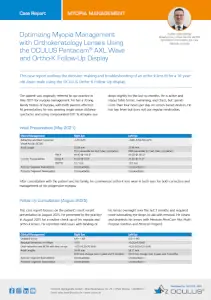
Contact Lens Fitting
How to Check Ortho-K
with the Pentacam®
Quickly, Simply, Precisely
The Pentacam® was developed in order to highlight complex changes in the cornea. And that’s what’s so crucial in the Ortho-K process. With the latest Pentacam® display, you can now evaluate orthokeratology contact lenses even more quickly and precisely than before, aided by its intuitive visualisation. This makes it easy for you to share complex results with your customers.
Discover the key functions and advantages for Ortho-K Follow-up now:
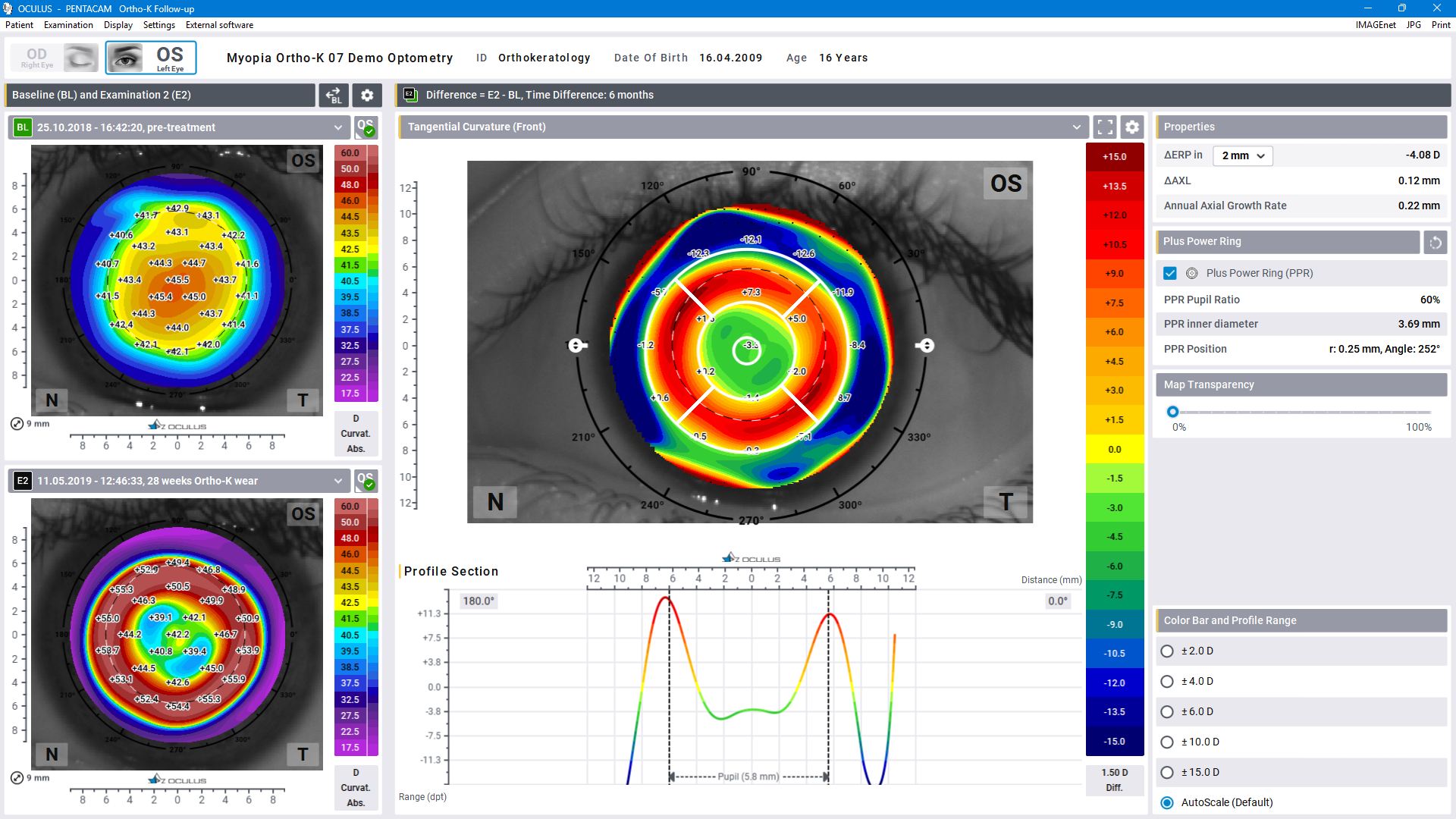
Use Pentacam® Ortho-K Follow-up and integrate it into your patient care.
Clarity in Control:
A Smarter Way to Evaluate Ortho-K Outcomes
In this edition of the OCULUS Academy, Product Manager Pauline Sauer welcomes expert Dylan Bentley (Innovative Eye Care, Adelaide).
Together, they take a deep dive into the new Pentacam® Ortho-K Follow-up Display.
What you will learn in this video:
- Software Introduction:
How to navigate the new Ortho-K display and set correct baselines. - Map Interpretation:
The difference between axial, tangential, and the new Epithelial Reshaping Power Maps. - Plus Power Ring (PPR) Pupil Ratio:
Why this value is important for success in myopia management. - Clinical Case Studies
You want to learn more? Contact us now!

RGP
Contact lens fitting software including Fourier analysis, integrated contact lens database and realistic fluo image simulation.
Precision Scleral Lens Fitting
with the Pentacam®
As you know from your daily practice, fitting scleral lenses is a complex process. You carry a significant clinical responsibility, particularly when managing keratoconus, post-refractive surgery cases, or irregular corneas.
The challenge: Traditional topographers provide reliable data for the cornea. However, they only capture a fraction of the area that scleral lenses actually cover. What lies beyond the cornea often remains unmeasured.
In your day-to-day practice, this means:
- Fitting decisions are partly based on assumptions
- More trial lenses and additional chair time
- Clinical outcomes are harder to predict
- Explaining the process to your patients becomes more complicated
Precision in Fitting:
A Smarter Way to Empirical Scleral Lens Fitting
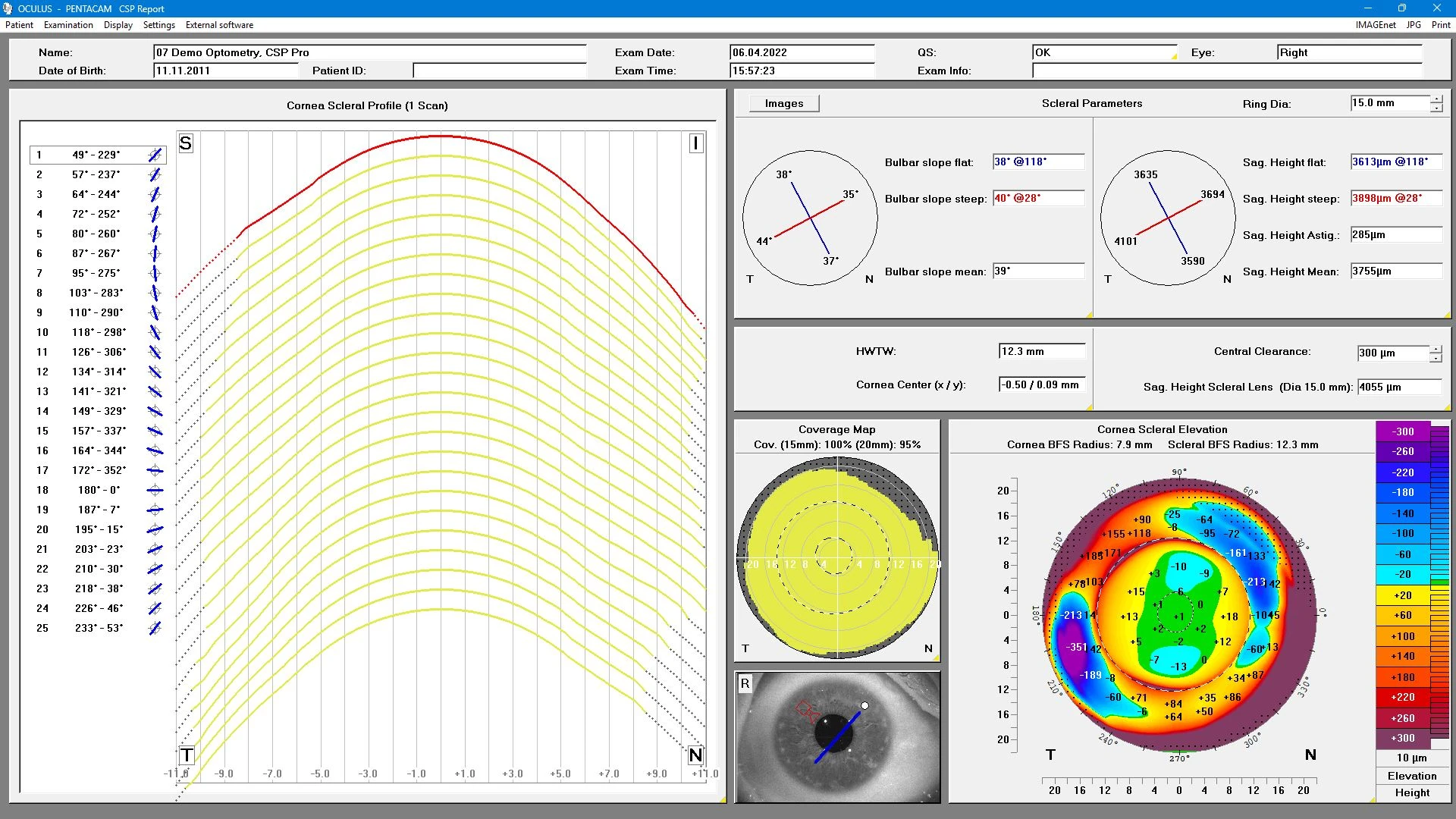
In this video series, contact lens specialist Daddi Fadel demonstrates how you can use the Pentacam® CSP Report for your scleral lens fitting.Learn how to analyze the shape of the sclera in detail, select a suitable lens, and predict how the lens will fit.
What you will learn in this video:
- Interpreting the Corneal-Scleral Elevation Map:
How to correctly read elevation maps, establish the relationship between the elevation map and sagittal height, and use this information to predict how a lens will sit on the eye. - Scleral Lens Fitting Using the Pentacam® CSP Report:
How to use the CSP Report effectively to determine lens parameters based on the scleral profile, making your fitting process more efficient. - The Relationship Between Scleral Profile and Lens Diameter:
How to select the appropriate scleral lens diameter based on scleral shape and simplify your scleral lens fitting. - Monitoring: Follow-Up Care for Scleral Lens Patients:
Use this case example to learn what to look for during follow-up care for scleral lens patients and gain greater confidence in managing special cases. - Corneal Diameter Measurement with the Pentacam®:
How to determine the horizontal and vertical corneal diameters in the CSP Report and use the data for lens fitting.
You want to learn more? Contact us now!